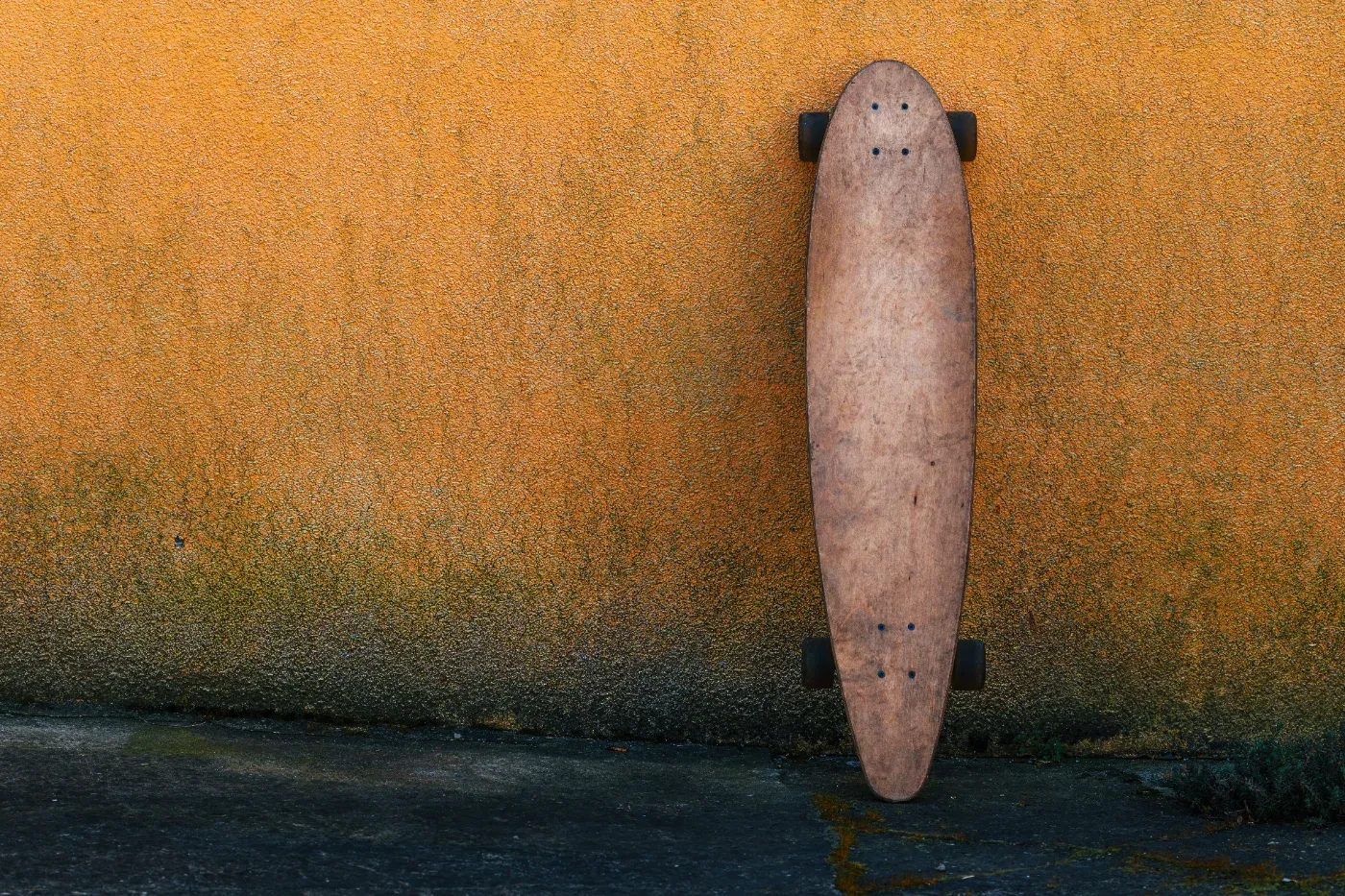
The question comes up constantly, and the answer is simpler than people think: these are not two versions of the same object. A longboard and a skateboard do different jobs, and the right choice depends only on what you want to do.
What actually separates them
Length and width. A standard skateboard is about 31 to 33 inches long and 7.5 to 8.5 inches wide. A longboard runs from 33 to over 50 inches, and is generally wider. Longer means more stable and less manoeuvrable.
The wheels. This is the most decisive difference. A skateboard has small hard wheels (52 to 56 mm, high durometer): quick to accelerate, perfect on smooth concrete, and stopped dead by a single pebble. A longboard has big soft wheels (65 to 75 mm): they absorb cracks, gravel and rough asphalt.
The tail. A skateboard has a kicked-up tail at the back, used to snap for an ollie. Many longboards have none, or none you can use: you do not ollie on them.
The trucks. Longboard trucks are often wider and mounted differently, for a smoother turn at speed.
Pick a longboard if…
You want to get around. That is its main job. Big soft wheels roll over sidewalks a skateboard refuses. On a daily commute the comfort difference is enormous.
You want downhill or cruising. A longboard is stable at speeds where a skateboard starts to wobble.
You are starting out and worried about balance. It is simply easier to stay on. Longer, wider, more stable.
Pick a skateboard if…
You want to learn tricks. Ollie, kickflip, the whole vocabulary of skating needs a tail. That is not a preference, it is a requirement.
You want to go to a skatepark. The features — rails, quarters, bowls — are built around a skateboard. A longboard is bulky and badly suited there.
You want to progress in a practice with a community. Quebec's 345 skateparks exist for that.
The cruiser: the middle ground nobody mentions
There is a third option beginners usually miss: the cruiser. It is a short skateboard, with a tail, fitted with big soft longboard wheels.
The result rolls over imperfect asphalt like a longboard, stays portable, and keeps a tail that lets you hop a curb. It is not ideal in a skatepark, but for someone who mainly wants to get around while keeping the door open, it is often the better buy.
And for a child?
A smaller complete skateboard, with a helmet and wrist guards. A longboard is too long to be manoeuvrable at a small size, and it is the neighbourhood skatepark that will make them want to keep going — not the ride to school.
The real deciding question
Ask yourself one thing: do I want to learn tricks?
If yes, skateboard. There is no alternative.
If no, and you want to get around comfortably, longboard or cruiser depending on distance and storage space.
The trap to avoid is buying a longboard because it "looks easier", then wanting to do tricks three months later. That is how people end up with two boards.