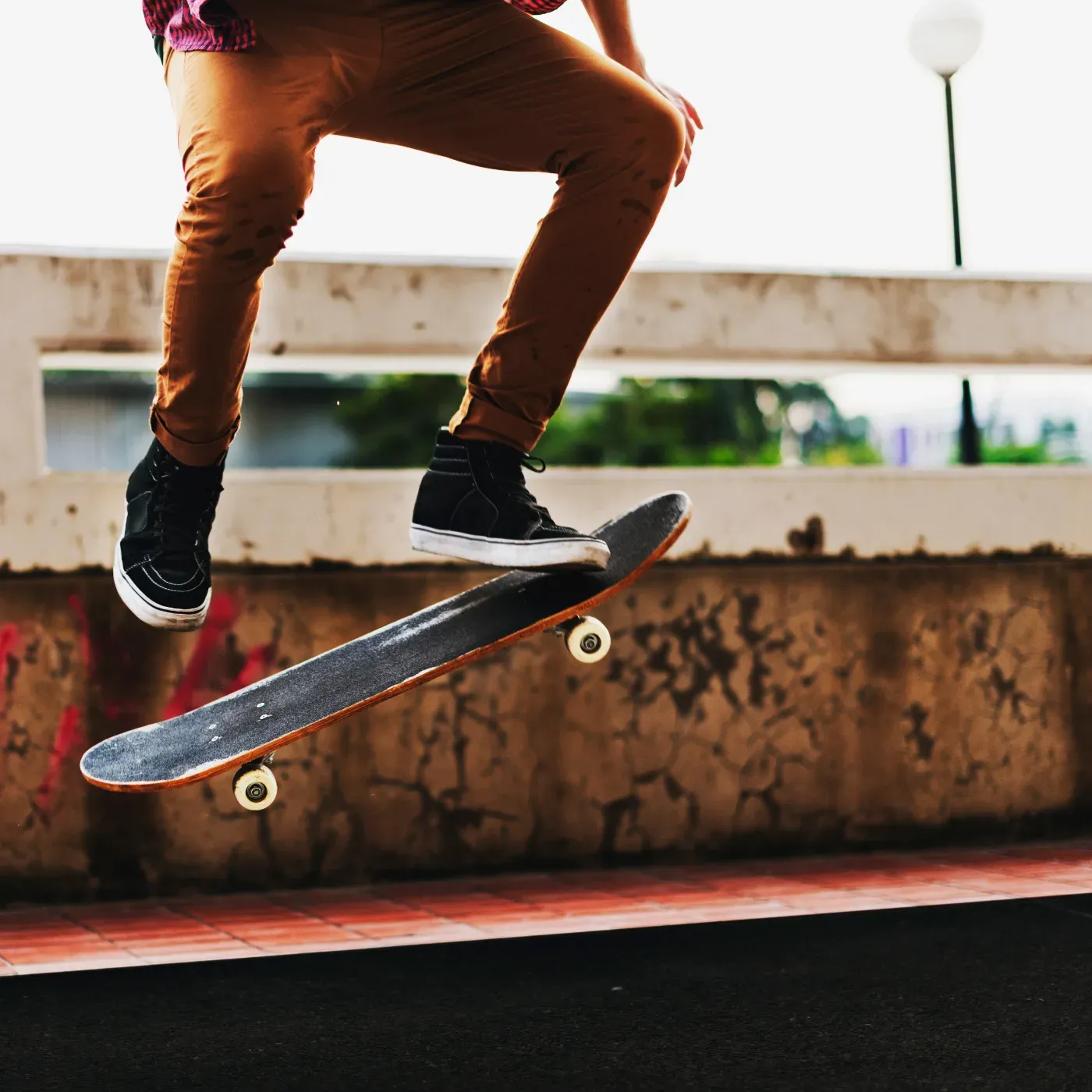
The ollie is the jump that lifts the board off the ground without grabbing it. Almost every street trick builds on it: no ollie, no kickflip, no hopping a curb, no clearing an obstacle. It is also the trick most beginners get stuck on — usually for one specific reason they cannot see.
What an ollie actually is
An ollie is not a jump where you pull the board up with your feet. It is two movements in sequence: you snap the tail against the ground, and while the board rebounds, you slide your front foot toward the nose to level it out in the air.
Understanding this changes everything. If you try to "jump with the board stuck to your feet", you will never get there, because nothing is sticking it. The tail snap supplies the energy; the front foot supplies the direction.
The starting stance
Back foot on the tail, the ball of the foot on the edge, heel hanging slightly off. If your whole foot sits flat on the tail, you have no leverage to snap.
Front foot in the middle of the board, just behind the front bolts, slightly angled. It needs to be able to slide forward without anything in its way.
Shoulders in line with the board. Knees bent. Eyes ahead, not on your feet — it feels wrong, and it is the single thing that stabilizes you most.
The movement, broken down
1. The crouch. Bend your knees properly. An ollie comes from the legs, not the back. The lower you are, the more travel you have for the snap.
2. The snap. Drive your back leg down sharply to strike the tail against the ground. The sound should be clean: a crack, not a scrape. At the same time, your body starts rising.
3. The slide. This is the step almost everyone who is stuck is missing. Right after the snap, the front foot slides up the board toward the nose, the outer edge of the shoe dragging on the grip. That friction is what levels the board out.
4. The suck-up. Both knees come up toward your chest. The board follows your feet — it is not pulled, it goes along.
5. The landing. Both feet come back over the bolts, never in the middle of the board: that is the fastest way to snap a deck and hurt yourself. Bend your knees on impact to absorb it.
The four mistakes that stall people
The front foot does not slide. By far the most common. The board lifts on one side, stays tilted, and lands crooked. If your shoes show no wear on top after a few sessions, that is the tell: the foot is not dragging.
The snap is not sharp enough. A tail pushed down slowly does not make the board rebound. It is a strike, not a press.
The shoulders turn. If they open during the jump, the board goes diagonal. Keep them parallel to the board from start to finish.
Looking at your feet. The body follows the eyes. Pick a point ahead of you.
What order to work in
Do not start rolling. The order that saves the most time:
- On grass or a mat. The board does not move, so you can repeat the movement a hundred times without managing balance. This is where the front-foot slide gets learned.
- Stationary, on concrete. Same movement, but the board can now shoot out. You learn to keep it under you.
- Rolling slowly. This is easier than stationary, counterintuitively: speed stabilizes you.
- Over a line, then over a low obstacle.
How long it takes
Honestly: weeks, not hours. That is normal, and it is not about talent. An ollie asks you to coordinate two opposite movements — pushing down and sliding up — in a precise order, within a tenth of a second. The body needs the repetitions.
A helmet and wrist guards make those weeks considerably more pleasant. Ollie falls almost always go backward, and the hands go down first.