The official PDGA rules, scoring, minimum equipment requirements, and where to play in Quebec—everything you need for your first disc golf round, complete with rule numbers for reference.
Disc golf—which many people still call “Frisbee golf”—is one of the most accessible outdoor sports in Quebec: most municipal courses are free, you only need one disc to get started, and you can play with your family right from your very first outing.
The concept can be summed up in one sentence: throw a disc from the tee to a target in as few throws as possible. It’s like golf, but with a disc instead of a ball and a chain basket instead of a hole.
This guide covers everything you need to play your first round properly: the official rules, scoring, the minimum equipment required, and where to play in Quebec. The rules cited here are taken from the [official PDGA rules](https://www.pdga.com/rules/official-rules-disc golf) (Professional Disc Golf Association), the international governing body for the sport—with rule numbers included so you can verify them.
What is disc golf?
The PDGA defines it as follows (Rule 800): “Play on each hole begins at the tee and ends at the target. After the tee shot, each subsequent throw is made from the spot where the previous throw came to rest. ”
In practice:
- A course typically has 9 or 18 holes (the exact word in the rule is “typically”—it’s not a requirement).
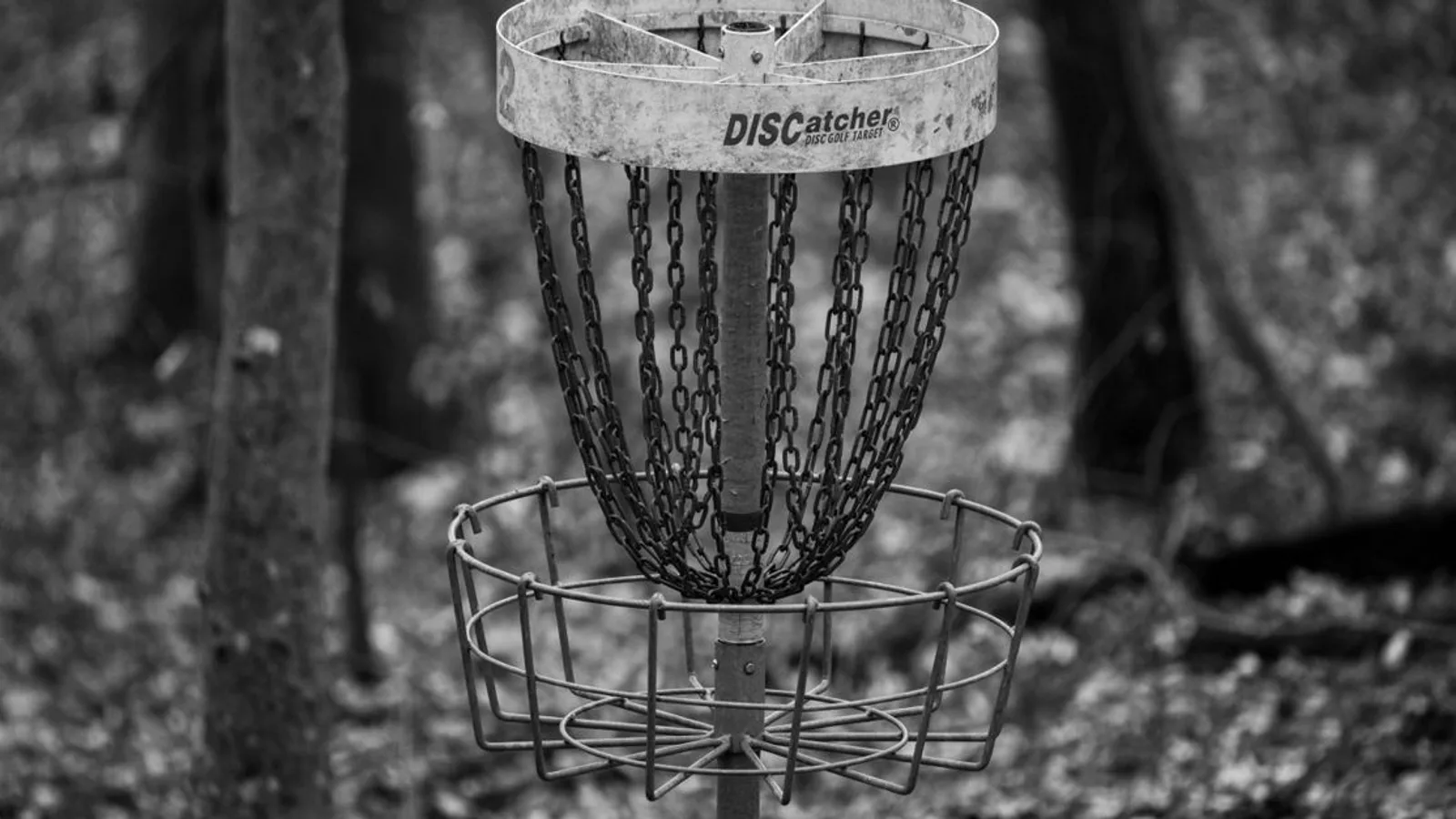
- Each hole has a teeing area (often a concrete slab) and a target: a metal basket equipped with chains.
- You throw, walk to your disc, and throw again from there. And so on until you reach the basket.
- The lowest score wins.
There is no limit to the number of discs a player can carry—unlike traditional golf with its 14 clubs. Nothing in the PDGA rules specifies the number of discs; they only address their legality (Rule 813).
Disc golf, Frisbee golf, or Ultimate: What’s the difference?
This is the most common source of confusion, and it deserves a clear answer.
| Disc golf | Ultimate | |
|---|---|---|
| Type | Individual sport, against the course | Team sport, 7-on-7 |
| Objective | Fewest throws to the basket | Score in the opponent’s end zone through passing |
| Disc | Small and streamlined (≈ 21 cm) | Large and thick (≈ 27 cm) |
| Contact | None | The disc is passed between players |
“Frisbee golf” and “disc golf” refer to the same sport. The difference is a matter of branding: Frisbee is a registered trademark of Wham-O. The official name of the sport is therefore disc golf, and that’s what you’ll see on courses and in the rules. “Frisbee golf” remains the popular name—both are used, and no one will correct you at the park.
Ultimate, on the other hand, is a completely different sport: a team, passes, an end zone. The only thing they have in common is throwing a disc.
How a Hole Plays Out
1. The Tee-Off
You throw from the tee box. The foot rule (802.04) is specific: at the moment of release, you must have at least one supporting point within the tee box, and all your supporting points must be within that area. You may step off the tee after the release—not before. A violation results in a 1-stroke penalty.
A “supporting point” is any part of your body in contact with the ground or with an object supporting you at the exact moment of release.
2. Subsequent Throws
Where the disc comes to rest becomes your lie—the position from which you throw again. Officially (802.05), this is a rectangle 20 cm wide by 30 cm deep behind the front edge of your marker.
You mark the lie (802.06) either by leaving the disc where it is or by placing a mini-marker touching the front of the thrown disc, then picking up the disc.
The foot rule changes here (802.07). At the moment of release, you must have:
- at least one foot in contact with the lie;
- no foot closer to the target than the back edge of the marker;
- all feet within the boundaries.
The nuance that many overlook: at the start, all of your feet must be within the area. On a normal lie, only one foot needs to touch the lie—the rest can be elsewhere, as long as nothing is in front of the marker.
3. Order of Play
On the first hole, play follows the order on the scorecard. After that (802.02), the player with the best score on the previous hole plays first. Once everyone is in play, the player farthest from the target plays (away player). Playing out of turn is not a stroke penalty—it’s a breach of courtesy.
4. Completing the Hole
Here is the rule that beginners most often overlook (807): “To complete a hole with a basket, the thrower must release the disc, and it must come to rest supported by the basket or by the chains beneath the chain support.” ”*
In other words: a disc that hits the chains and bounces out has not completed the hole. It must remain inside. This happens often, it’s frustrating, and it counts.
Basic Rules to Know
The 10-meter circle (putting)
Any throw made within 10 meters of the target is a putt (806.01). The distance is measured from the front of your lie to the base of the target—not to the basket itself.
Within this circle, there’s only one rule: after releasing the disc, you must demonstrate complete control of your balance behind the marker before moving toward the target. Failure to do so results in a 1-stroke penalty.
Two clarifications that dispel persistent myths:
- The straddle putt (feet apart) is perfectly legal. The terms “straddle” and “falling putt” do not appear anywhere in the official rules. What is penalized is moving forward without first demonstrating balance—not the position of your feet.
- Demonstrating ≠ maintaining. The PDGA clarifies this itself: you can then drag your feet, fall to the side, or fall backward. You only need to demonstrate balance first.
Outside the circle, jump putts and step putts are allowed: you can step past your marker after releasing the disc.
Out of Bounds (OB)
A disc out of bounds incurs a 1-stroke penalty (806.02)—not 2. This is the most common mistake in articles on the subject.
A disc is OB only if it is “clearly and completely surrounded by an out-of-bounds area”. The line itself is part of the OB area.
You then have a choice: replay from the previous lie, or from a marked lie up to 1 meter from the point where the disc crossed the line, perpendicular to the line.
Good to know: If your disc is in-bounds but within 1 meter of an OB line, you can move your lie back up to 1 meter without any penalty.
The Mandatory (“Mando”)
A mandatory (804.01) requires the disc to pass on the correct side of a vertical plane marked by a tree or a sign. Missing it costs 1 stroke, and you replay from the designated drop zone, or from your previous lie if there isn’t one.
The Lost Disc
You have 3 minutes to find a disc (805.03), starting from the moment you arrive in the area where it should be—not 5 minutes, as is often stated. After this time has elapsed: 1 penalty throw, and you replay from the previous lie.
Note: All players in the group must help search. Failure to do so is a breach of courtesy.
Scoring
Rule 808 is simple: “A player’s score on a hole is the total number of throws, including penalty throws.” The round total is the sum of the hole scores.
The par is “the score an expert disc golf player would be expected to achieve on a given hole, playing a flawless round under normal weather conditions” (PDGA Par Guidelines). It is not a value determined by distance: it is set by the tournament director (Rule 811).
One point of clarity that few articles mention: the terms “birdie,” “bogey,” and “ace” do not appear in any official PDGA text. They are borrowed from traditional golf and universally used by the community, but they are not official terms. They are used as follows:
- Birdie: one stroke under par
- Bogey: one stroke over par
- Ace: a one-putt hole, directly from the tee
👉 Details and complete vocabulary: [How to Score in Disc Golf](/guides/disc golf-scoring)
The Minimum Gear You Need to Get Started
Good news: it’s the least expensive outdoor sport to get into.
How many discs? Reputable sources are clear: “You only need one disc to play and have a great time.” Reputable sources recommend starting with 1 to 3 discs—ideally a putter and a midrange—and especially no distance driver, since beginners don’t have the arm speed to throw it properly.
How much does it cost? In Quebec (prices checked at Canadian retailers in July 2026):
- A single disc: $20 to $30 CAD (median ≈ $25)
- A beginner’s set of 3 discs: $35 to $50 CAD — cheaper than buying all 3 separately
Add a bag (optional at first) and some good shoes. That’s it.
👉 Complete guide: [Which discs to choose as a beginner](/guides/choosing-discs-for-beginner-disc golf)
Can you play with a regular Frisbee?
Short answer: yes, but you’re setting yourself up for failure — and the official answer might surprise you.
The Discraft Ultra-Star, the official disc for Ultimate, has been PDGA-approved since 1981 (certification 81-02). It is therefore perfectly legal in PDGA tournaments. What’s approved is the specific model, not the category: a generic beach Frisbee or a promotional disc, on the other hand, is illegal.
But physically, it’s a whole different story: the Ultra-Star is 27.3 cm in diameter compared to 21.1 cm for a driver, it’s more than twice as thick (3.2 cm vs. 1.4 cm), and its thick, rounded rim is designed to be caught by hand, not to slice through the air. The result: it glides, it doesn’t cut through the air—and its large diameter makes it pop out of the chains much more often when putting.
👉 Detailed analysis: [Can you play disc golf with a regular Frisbee?](/guides/choosing-discs-for-beginner-disc golf)
The Numbers on Discs
You’ll see four numbers printed on almost every disc, always in the same order: speed · glide · turn · fade.
The number one misconception: speed isn’t the same as distance. It’s the arm speed required for the disc to fly as intended. A beginner throwing a speed 13 disc will see it drop to the ground—a speed 6 disc will travel farther in their hands.
👉 Learn more: [The Numbers on Discs Explained](/guides/chiffres-disques-disc golf)
How to Throw
The two basic throws are the backhand—the most natural one, like in beach Frisbee—and the forehand (or sidearm).
The most important tip for a beginner is summed up in this quote from Innova: “ Many players throw just as far at 50% power as they do when trying to throw at full speed. The difference is in the timing.”
Distance comes from timing and hip rotation, not arm strength. Using too much force desynchronizes the sequence of legs → hips → torso → arms, and accuracy goes out the window along with it.
👉 Complete technique: [How to Throw a Disc Golf Disc](/guides/lancer-disque-disc golf)
Where to Play Disc Golf in Quebec
We’ve identified [69 disc golf courses in Quebec](/disc golf), mainly in Montérégie (19), Centre-du-Québec (7), Estrie (6), and Chaudière-Appalaches (5). Other directories list between 58 and 72 courses, depending on their methodology—the discrepancies stem from informal, 9-hole, or seasonal courses.
It’s free in most municipal parks. This has been confirmed in writing by several cities: Boucherville (“Cost: Free”), Victoriaville, Rimouski, and Le Monstre in Quebec City (“access to the courses is free year-round”). You bring your discs, you play.
Exception: Private sites and ski resorts (Mont-Sainte-Anne, Camp Fortune, Mont Sutton) generally charge a fee.
What about winter? Disc golf is played year-round on several courses in Quebec—Le Monstre is open year-round and simply recommends renting discs in winter to minimize losses in the snow. No official source specifies a “peak season” period: the main season obviously follows the snow-free months, but there’s nothing stopping you from playing in January.
Associations: There are regional associations—the ADGM (Montreal), the ADGQ (Quebec City and Lévis metropolitan area), and the ADGCQ (Centre-du-Québec). Beware of the name trap: despite its name, “Association de Disc Golf Québec,” the ADGQ explicitly limits its mission to the Québec–Lévis region. There is no provincial disc golf federation in Quebec; the governing body for tournaments is the PDGA, which is international.
Course Etiquette
Nothing complicated, but it makes all the difference for other players:
- Never throw if a group is within range ahead of you.
- Be quiet while others are throwing.
- The player farthest from the basket plays first.
- Help look for lost discs (it’s in the rules).
- Let faster groups pass.
- Pick up your trash, stay on the trails, and respect the park.
Frequently Asked Questions
Is disc golf a real sport?
Yes. It is governed by an international organization (the PDGA), with official rules, sanctioned tournaments, a world ranking, and professional players.
How many holes are there on a course?
Typically 9 or 18, according to PDGA Rule 800. Many municipal courses in Quebec have 9 or 12 holes.
Do you need a special disc?
Not necessarily—a Discraft Ultra-Star (an ultimate frisbee) is even PDGA-approved. But a real disc golf disc, which is smaller and more streamlined, flies much farther and stays in the chains. Expect to spend $20–$30 to get started.
How long does a round take?
Allow about 1 to 1.5 hours for 9 holes, and 2 to 3 hours for 18 holes, depending on the number of players and the course’s difficulty.
How much does a round cost?
Nothing at the vast majority of municipal parks in Quebec. Only certain private sites and ski resorts charge for access.
Can families play together?
Yes, that’s one of the sport’s biggest draws: there are no age or fitness restrictions for a recreational round. For children, choose lighter discs.
How many discs can you carry?
As many as you want. There’s no limit in the PDGA rules—unlike the 14 clubs in golf. You can even add discs during a round.
Learn More
This guide is just the starting point. The following four guides go into more detail:
- [How to Throw a Disc Golf Disc](/guides/lancer-disque-disc golf) — backhand, forehand, grip, and beginner mistakes
- [Which discs to choose as a beginner](/guides/choosing-disc golf-discs-for-beginners) — and the truth about regular Frisbees
- Disc Numbers Explained — speed, glide, turn, fade
- [How to Score](/guides/disc golf-scoring) — scoring and terminology
- [Building a Disc Golf Course](/guides/building-a-disc golf-course) — and a homemade basket
Then find a course: [Quebec’s 69 disc golf courses](/disc golf).