Design a safety course, build a basket, and set up a project with your municipality in Quebec.
Whether it’s a basket in your backyard for practicing putts or a real 9-hole course in a municipal park, both are within your reach. Here’s how to go about it, from the simplest to the most ambitious.
First: What the PDGA Regulates (and What It Doesn’t)
An important point to keep in mind: the PDGA does not dictate how to design a course. It regulates discs (Rule 813) and the game, not the layout of your course.
What it defines that applies to you:
- A course typically has 9 or 18 holes (Rule 800) — “typically,” not necessarily. Many courses in Quebec have 9 or 12 holes.
- The par is determined by the tournament director or the course designer (Rule 811). You set the par for your holes.
- Completing a hole (Rule 807) requires a target that holds the disc—a basket or chains. This is the only real equipment requirement.
In other words: for a private or backyard course, you have free rein.
Building a Homemade Basket
A real disc golf basket is expensive. A homemade basket is a great way to get started—especially for practicing putting, which is the most rewarding skill to work on.
The 4 components of a basket:
- The central pole—a vertical pipe, anchored or mounted on a base
- The chain support—the upper ring
- The chains—suspended, they cushion the disc
- The tray — the bottom basket that holds the disc
The role of the chains is often misunderstood: they are not just for decoration. They absorb the disc’s energy so that it falls into the tray. Without sufficient chains, the disc bounces back out—and according to Rule 807, the hole is not completed.
Common DIY setups:
- A PVC or steel frame with hardware store chains and a metal basket
- A metal laundry basket mounted on a pole, with chains hanging from it
- A flexible target (net)—not regulation, but sufficient for practicing accuracy
⚠️ Realism: A homemade basket will not behave like an official basket. The chains on a real basket are calibrated in number, weight, and arrangement. It’s perfect for practice. But it’s not suitable for judging whether a putt “would have gone in” during a competition.
An official basket (PDGA-approved) costs several hundred dollars—it’s an investment worth making only if you’re setting up a real course or a league.
Designing a Course
The Principle: Variety Over Length
The beginner’s mistake in course design is thinking “long = good.” A good course is all about variety:
- Short, technical holes (60–75 m) where you have to weave your way through
- Medium holes (75–110 m)—the heart of a course
- A few long holes (110 m+) that reward distance
- Turns in both directions (left and right)—otherwise you’ll systematically favor right-handers
- Elevation changes if the terrain allows
A course where all 9 holes turn to the left is a poor design: right-handed players using a backhand throw will have an advantage on every hole.
Reference Distances
To calibrate, use the actual flight distances by disc type:
| Type | Typical Flight Distance |
|---|---|
| Putter | 15–60 m |
| Midrange | 45–90 m |
| Fairway driver | 75–115 m |
| Distance driver | 90–150+ m |
A typical par 3 ranges from 60 to 110 m: a drive + an approach shot + a putt. Below 60 m, the hole becomes an “ace run.” Beyond 120 m, a par 3 becomes challenging for a recreational player.
👉 [Disc numbers explained](/guides/disc-numbers-disc golf)
Safety: The Non-Negotiable Factor
This is what determines whether a municipality approves or rejects a project:
- No fairway may cross a pedestrian path, a playground, a parking lot, or a bike path
- Allow for a buffer zone on either side of the fairway—beginners tend to throw wide
- Space out the holes: the tee of one hole must never be within the landing zone of another
- Visible signage in areas where non-players may pass
- Be mindful of bodies of water and sensitive areas
A 175-gram disc traveling at full speed can cause serious injury. This is the first question any city will ask.
The layout of each hole
- The tee area: ideally a flat, non-slip concrete slab or compacted gravel surface. Rule 802.04 requires a defined area; if no pad is available, the area extends 3 meters perpendicular to the tee line.
- The sign: distance, par, hole map. This is what makes a course playable for a visitor.
- Mandatories: If a passage is dangerous or too easy, a mando (Rule 804.01) requires the disc to pass on a specific side of a vertical plane.
- Out-of-bounds areas: Mark them clearly. The OB line is part of the OB area (806.02).
Setting Up a Course in a Municipal Park
This is the most common approach in Quebec—and it’s realistic, because most municipal courses here are free and run by volunteers.
The steps:
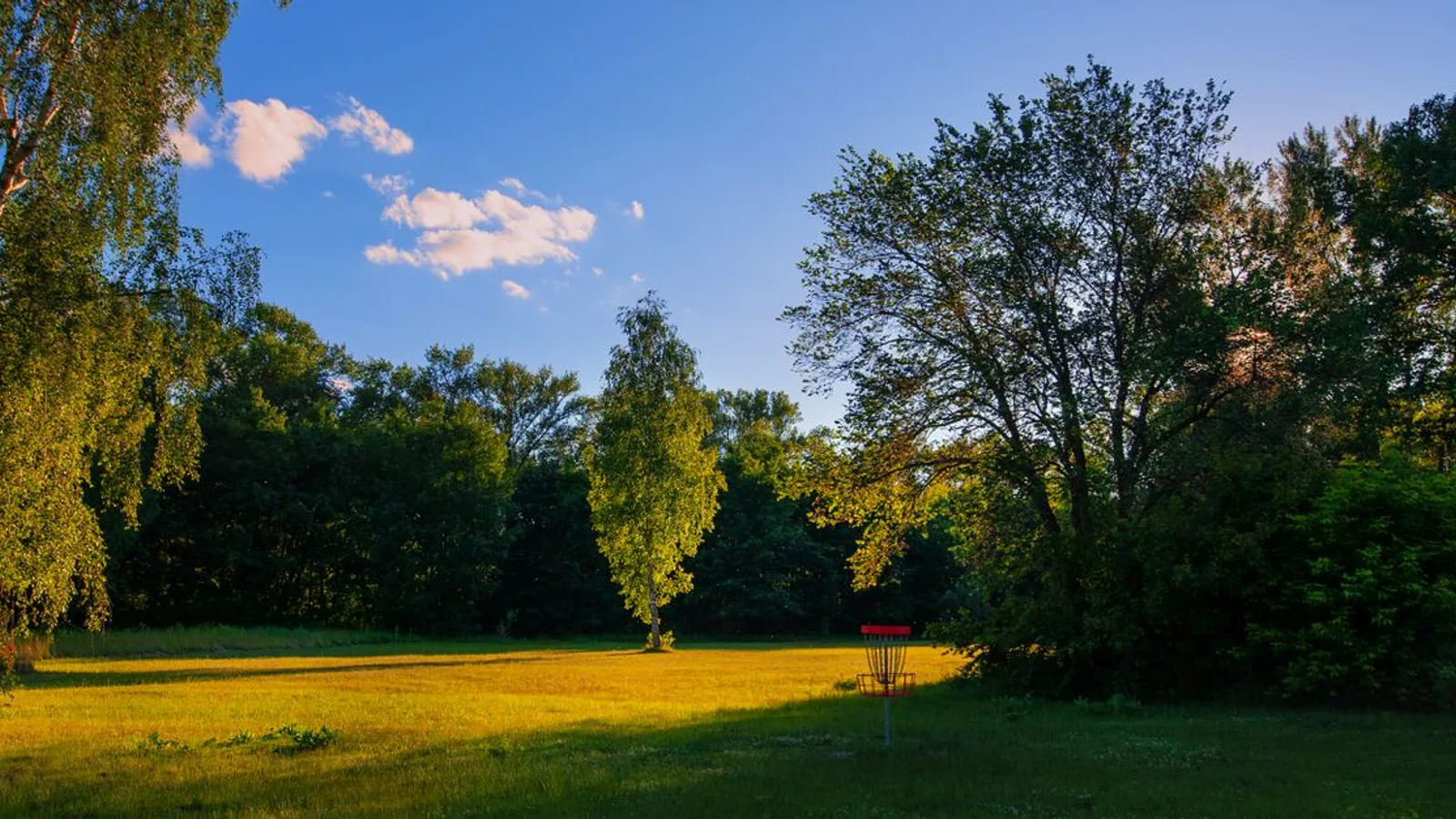
- Find the site: an underutilized wooded park is ideal. 3 to 5 hectares are enough for 9 holes.
- Talk to the municipality early on—the recreation or parks department. The project will belong to them; it’s best to have them on board as partners from the start.
- Prepare the proposal: hole layout, budget, safety, maintenance, and who pays for what. Safety will be their first concern.
- Reach out to a regional association: the ADGM (Montreal), the ADGQ (Quebec–Lévis), and the ADGCQ (Centre-du-Québec) have experience setting up projects. (Note: There is no provincial disc golf federation in Quebec—despite its name, the ADGQ limits its mission to the Quebec–Lévis region.)
- Start small: 9 well-designed holes are better than 18 poorly constructed ones. You can expand later.
- Plan for maintenance: mowing, pruning, repairing baskets, replacing chains.
The budget is dominated by the baskets: several hundred dollars each, multiplied by the number of holes. Tee pads and signage come next. This is where local sponsorship and municipal support make a difference.
A Temporary Course for an Event
For a neighborhood party, camp, or corporate event, forget about permanent baskets:
- Portable baskets (rented or borrowed from a club)
- Improvised targets: a marked tree, a cone, a hoop on the ground—the goal is to hit the target
- 9 short holes are more than enough
- Borrowed discs: most people don’t have their own
It’s also the best way to test a layout before setting it in concrete.
Frequently Asked Questions
How many holes should a course have?
Typically 9 or 18 (PDGA Rule 800), but there’s no strict requirement. Many courses in Quebec have 9 or 12 holes.
Can you make a homemade basket?
Yes, and it’s great for practicing putting. But it won’t perform like an official basket: the calibrated chains make all the difference.
How much space do you need?
Allow for about 3 to 5 hectares for a comfortable and safe 9-hole course. Less if the terrain is heavily wooded and the holes are short.
Do you need permission from the city?
Yes, for any public land. Contact the recreation or parks department. On private land that you own, you can do whatever you want.
What’s the ideal distance for a hole?
A recreational par 3 ranges from 60 to 110 m. Vary the course: a few technical short holes, some medium-length ones, one or two long ones—and turns in both directions.
How much does it cost?
The baskets are the biggest expense (several hundred dollars each). Add in tee pads, signs, and course markings. Local sponsorship and city support are key.
This guide is part of our disc golf series:
- 🏆 [How to Play Disc Golf: The Complete Guide](/guides/how-to-play-disc golf)
- [How to Throw a Disc](/guides/throwing-a-disc-in-disc golf)
- Which discs to choose as a beginner
- [Find a course near you](/disc golf) — 69 courses in Quebec