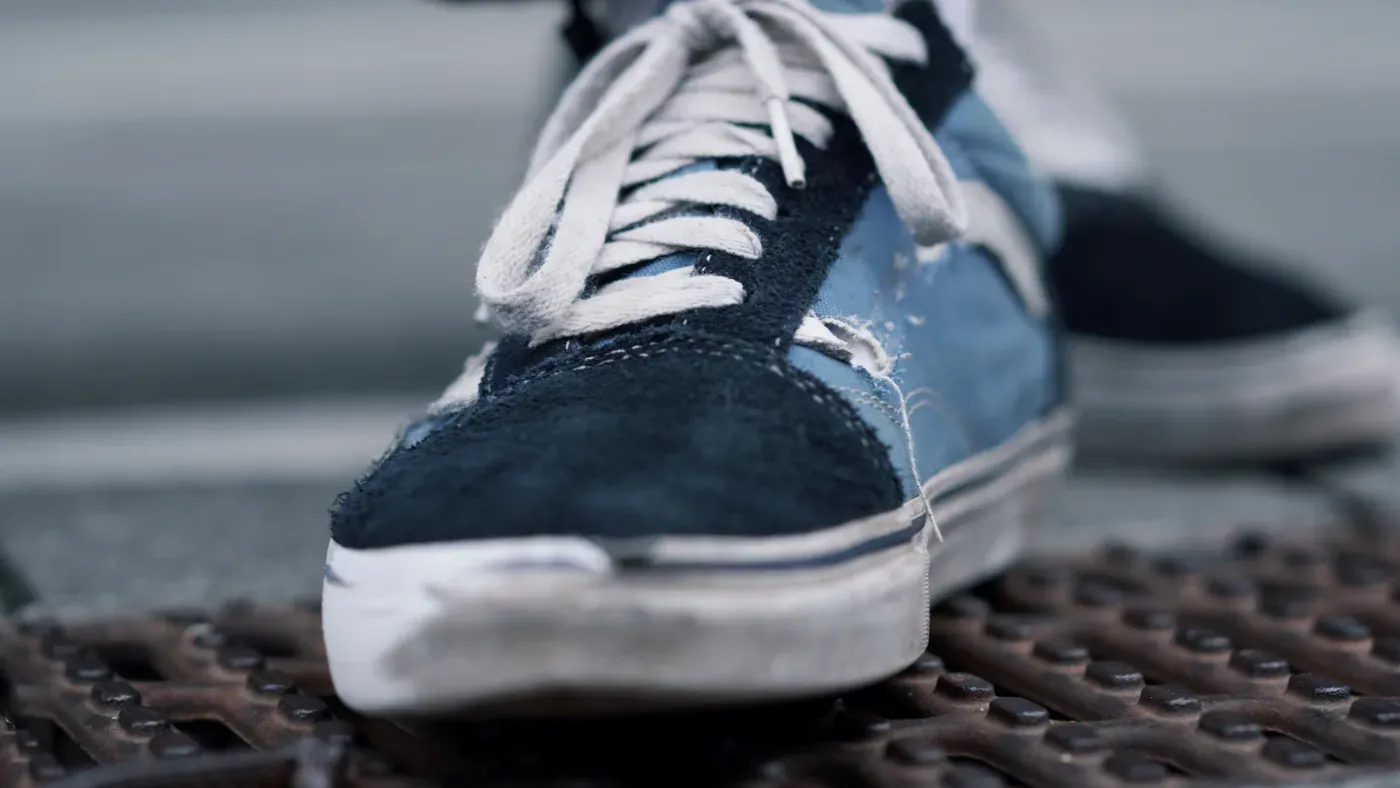
This is the purchase that changes the most for a beginner, and it is almost always the last one they think about. The wrong shoe stops you feeling the board, slips off the grip at the moment of the snap, and wears through in two weeks.
Why a running shoe does not work
Three reasons, all mechanical.
The sole is curved. A running shoe has a heel-to-toe drop and a rounded sole, designed to roll the foot through its stride. On a board, that curve reduces the contact patch to a few square centimetres: you stop feeling anything.
The sole is thick and cushioned. What is an advantage in running becomes a filter in skating. The information coming up from the board — where the tail is, where the bolts are — disappears into the foam.
The upper is not reinforced. The area over the little toe and the top of the foot rubs against the grip on every ollie. Running mesh wears through in a few sessions.
Vulcanized or cupsole: the real question
This is the main distinction between skate models.
The vulcanized sole. The rubber is glued and cured around the upper. The result is very flexible, very thin, with excellent board feel and good grip straight away. It is the classic choice for street and flatground. The trade-off is minimal cushioning: landing from height goes straight into your heels.
The cupsole. The sole is a moulded cup, stitched to the upper. Stiffer, thicker, considerably more cushioned and more durable. This is the choice for park, ramps and anything involving coming down from height.
For a first pair meant mostly for flatground and low features, a vulcanized sole gives the best feel.
Canvas or suede
Suede holds up considerably better against grip tape abrasion. It is the material used on the ollie patch of nearly every serious model.
Canvas is lighter and more breathable in summer, but wears out far faster in the same spot.
A common good compromise: suede on the wear zones, canvas elsewhere.
What to check in the store
- Is the sole flat? Set the shoe on a table: it should touch along its whole length.
- Is the rubber sticky? Run a finger over it. Hard, slick rubber will slip on the grip.
- Is the ollie patch reinforced? Outer side of the front foot, at the base of the toes.
- Is the collar padded? It protects the ankle bone from board strikes, which are frequent and painful.
High or low?
High-tops protect the ankles — useful in park and for anyone who has already had a sprain. Low-tops offer more freedom and run cooler. It is a preference, not a rule, barring a history of injury.
Making a pair last
Skate shoes wear out fast — that is inherent to the practice, not a defect.
Shoe glue (Shoe Goo and similar) applied before the hole appears, as soon as the fabric starts thinning, easily doubles their life.
Two pairs in rotation wear more slowly than two pairs one after the other: the rubber and the foam recover between sessions.
Keep them off your feet when you are not skating if you want them to last — pavement and stairs wear the rubber down for nothing in return.
What about "skate-inspired" models?
Be careful with this category. Plenty of sneakers sold as "skate" or "skate-inspired" copy the look — white sole, low profile — without the construction: non-vulcanized rubber, no ollie reinforcement, a sole that is not really flat.
The test is simple: check whether the brand sells that model in a distinct skateboarding line, and whether the listing mentions a vulcanized or cupsole construction. If it is written nowhere, it is a lifestyle sneaker.
What to spend
A genuine entry-level skate shoe runs around $60 to $80. Below that you are generally looking at a lifestyle model. Above it, you are mostly paying for cushioning technology and durability — worth it if you skate several times a week, unnecessary for two sessions a month.
Either way, it costs less than a board, and it changes more.